
The accessibility challenge at Abri
Abri delivers learning, information and communications that directly affect how customers access housing services and support. Internal research highlighted that many customers have disabilities or other access needs. This made accessibility an important consideration across internal training, digital content and external communications.
Inaccessible content creates barriers for customers, affects confidence in Abri’s services and introduces reputational, regulatory and governance risks. The learning team needed a consistent accessibility approach that teams could understand and apply in practice. They also wanted to build capability across the organisation without slowing delivery or relying on specialist roles.
What Abri needed
Abri needed a practical and repeatable approach to accessibility that could support employees across learning, marketing, communications and wider teams.
The organisation needed to:
- translate accessibility standards into clear actions
- build internal capability in accessible content creation
- create a consistent benchmark for current practice
- improve capability and reduce rework
- support evidence of good practice for regulators and governance teams.
The DALC Programme and eLa1000 assessment solution
Abri addressed their accessibility challenges through the Designing Accessible Learning Content (DALC) Programme, supported by the eLa1000 Accessibility Assessment.
The DALC Programme translated accessibility requirements into practical guidance that the learning team could apply directly to their work. Participants explored how decisions about structure, colour, imagery, multimedia, navigation and interaction could impact people with different access needs. This helped the team move from theoretical understanding to more confident decision-making and implementation.
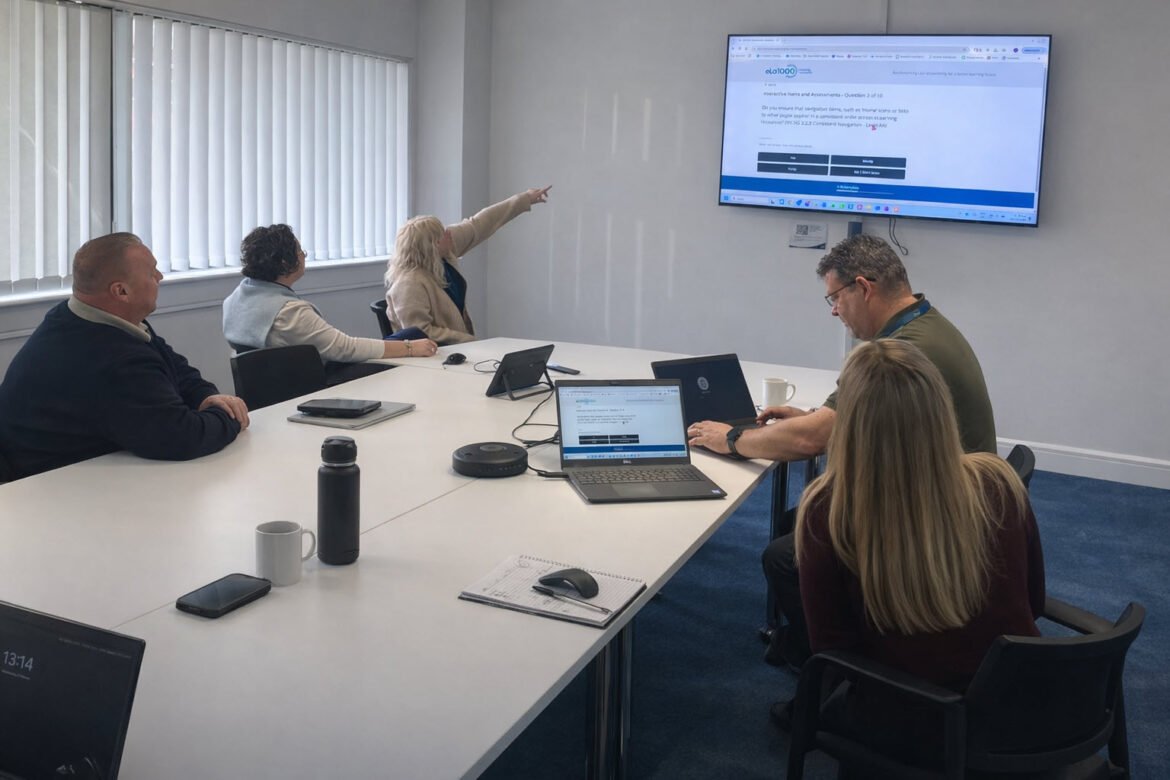
The eLa1000 assessment provided a shared benchmarking framework. It helped the team review current practice, identify areas for improvement and agree on the standard they were working towards. Together, the programme and assessment gave Abri both the knowledge and skills they needed to make changes and a structured way to evaluate progress.
How accessibility was embedded into Abri workflows
Learning from the DALC Programme was applied directly to real projects rather than treated as standalone training. The DALC Programme online discussion forum provided additional support. Participants could share experiences, ask questions and explore how accessibility applied to real scenarios. Consultancy feedback also helped the team address questions in context and make practical decisions with greater confidence. The eLa1000 assessment created a shared language for accessibility discussions and helped team members align their understanding.
This combination enabled the learning team to lead wider accessibility initiatives and share accessible practice with marketing, communications and other colleagues.
Key outcomes and impact
The DALC Programme and eLa1000 assessment helped Abri move from individual knowledge to organisation-wide capability. Teams became more confident in designing and reviewing accessible content, while clearer expectations reduced uncertainty and avoidable rework.
The learning team also used the programme’s frameworks and materials to extend accessibility beyond learning and into communications, social media and design. Through internal sessions, practical guidance and ongoing support, colleagues developed a stronger understanding of accessibility and began applying it more consistently in their own work.
This led to immediate improvements in live communications, greater collaboration across teams and a wider sense of shared responsibility. Two additional staff members are now due to complete the DALC Programme, extending capability further across the organisation.
Accessible learning as a catalyst for wider change
Abri’s experience shows how accessible learning can provide a practical starting point for wider digital accessibility improvements. By combining structured training, benchmarking, discussion and expert feedback, the learning team developed the confidence and capability to improve its own work and influence practice across the organisation.
The result was a clearer, more consistent approach to accessible learning and communication, supported by internal capability that can continue to grow over time.
Key results
The main outcomes achieved through the DALC Programme and eLa1000 assessment included:
- greater confidence in designing and reviewing accessible content
- a shared understanding of accessibility across teams
- practical guidance that colleagues could apply to everyday work
- more consistent practice across learning, marketing and communications
- reduced uncertainty and avoidable rework
- immediate improvements to live communications, social media and design
- increased collaboration and shared responsibility across teams
- stronger assurance against regulatory and governance expectations.