

Assumptions about disability can influence who learning is designed for. Our real-life colour blindness case study shows why accessible learning should be the default.
Early on in our consultancy work at eLaHub, we were working with a client and had a conversation about a particular access need and how we could include it in the learning content we were working on together. The client’s response to the scenario was one that we’d heard many times before in our advocacy work.
“But someone with that disability wouldn’t be able to do this job.”
We knew these statements needed to be challenged, but we hadn’t yet developed a confident way to address them. We wanted to respect the client’s knowledge of their organisation whilst also helping them recognise where audience analysis could be influenced by unsupported assumptions and biases.
That conversation led us to develop our eLaHub Access Without Assumptions Case Study using the real-life experience of our Creative Director, Tim Miller. It allowed us to explore the difference between genuine role requirements, reasonable adjustments and assumptions about what disabled people can and can’t do. It also influenced the development of our eLaHub Access Needs Mapping activity, which helps practitioners connect accessibility with real people and recognise how easily access needs can be non-visible, overlapping or misunderstood.
Together, the two activities help teams move away from deciding in advance who is likely to need accessible learning and towards a more useful question:
“How can we make sure everyone who needs the learning has a fair opportunity to participate and demonstrate what they can do?”
When assumptions about the audience narrow the learning experience
Understanding the intended audience is a fundamental part of learning design. Problems arise when assumptions about people’s capabilities begin to influence who the learning is designed for and which accessibility requirements are considered necessary.
A person’s disability or access need does not tell us everything about:
- what they can do
- how they complete a task
- what technology they use
- which reasonable adjustments are available
- whether the perceived barrier is essential to the role or simply part of how the role has traditionally been carried out
When inaccessible learning is justified by the belief that a disabled person could not do the job, those assumptions can become embedded in the design. The learning itself may then prevent someone from developing or demonstrating the required capability, excluding them before they have had any opportunity to participate.
Building the case study around a genuine role requirement
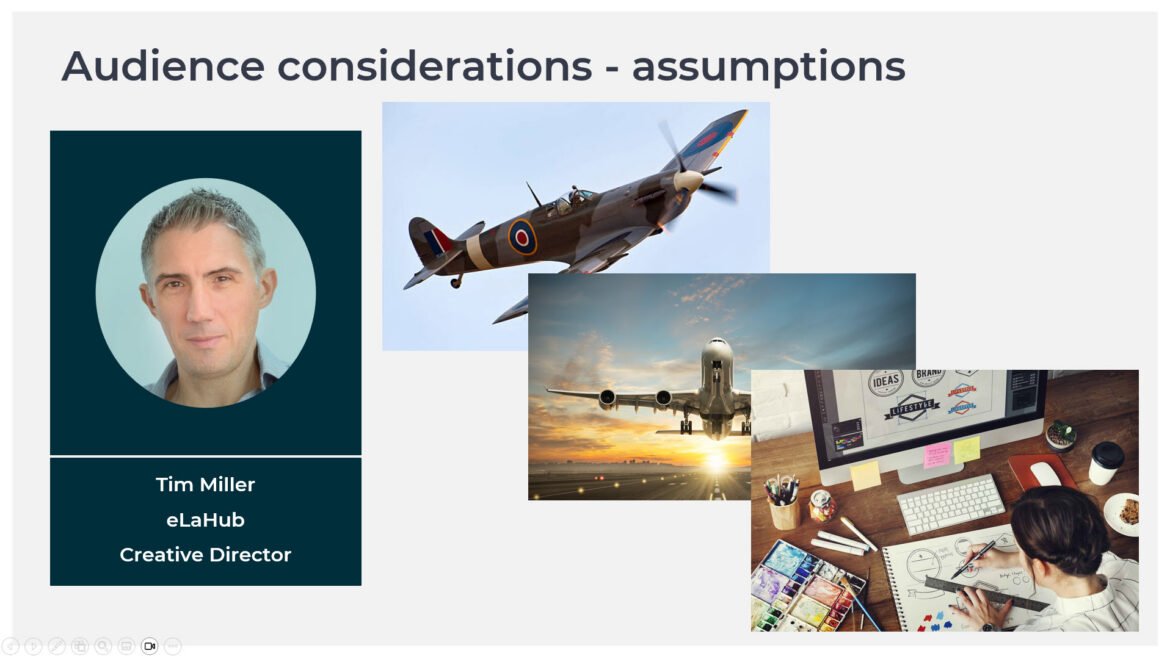
We decided that the most effective way to challenge this issue was through a case study showing how assumptions can restrict both learning and opportunity. Our earlier accessibility work had already taught us the value of grounding technical discussions in a human story, so we turned to the real-life experience of our Creative Director, Tim Miller.
As a child, Tim desperately wanted to become a pilot in the Royal Air Force. During a routine colour vision test at school, however, he discovered that he had colour vision deficiency, commonly known as colour blindness. That result meant that he could not follow his dream of becoming an RAF pilot. RAF pilots were required to meet a specified colour-perception standard as part of the medical and safety requirements for the role.
This gave us an important starting point for the case study. Tim’s colour blindness genuinely affected his eligibility for that particular safety-critical role. A learning team designing training exclusively for serving RAF pilots at that time might reasonably have concluded that colour blindness would not be present within the intended audience because every learner would already have met the relevant entry standard.
Crucially, that conclusion would have been based on an evidenced occupational and medical requirement. It would not have been based on a learning practitioner’s assumptions about what someone with colour blindness could or could not do.
Why evidence must shape the learning audience
Tim’s experience also revealed another important distinction. His careers adviser explained that, although he could not follow his dream of becoming an RAF pilot, he might still be able to become a commercial pilot because civil aviation applied a different assessment process.
Some people who are colour blind may still meet the medical requirements for commercial flying following appropriate testing. For example, currently applicants for an initial UK Class 1 medical certificate, which is required for professional flying, take an Ishihara colour vision test. Someone who does not pass that initial test can be referred for further colour-perception testing. An applicant who demonstrates that they are ‘colour safe’ may still be assessed as medically fit, while someone who fails the additional assessment will not qualify for the Class 1 certificate.
Being colour blind therefore, does not automatically exclude every person from every pilot role. Eligibility depends on the requirements of the role and an individual professional assessment.
Applied to learning, a team creating training for commercial pilots could not assume that colour blindness would be absent from the audience. Some learners may be colour blind while still being fully eligible for the role, so essential information should never be communicated through colour alone.
The key point is that decisions about who can perform a role must be based on evidence, professional assessment and genuine role requirements. They should not be made by a learning team based on a broad disability assumption about what someone with a particular condition can do.
The graphic designer people might assume could not do the job
The third and final part of the case study focuses on Tim’s career as a graphic designer and Creative Director. For many years, he chose not to share that he was colour blind because he did not want other people’s assumptions to limit the opportunities available to him.
Later in his career, particularly as an agency director, he became much more confident about discussing it. He understands which colours he can find difficult to distinguish and has developed effective ways of working around this, including checking decisions with colleagues where needed. Being colour blind has never prevented him from building a successful creative career spanning more than 30 years.
Yet this is exactly the kind of situation where someone might say:
“But someone with that disability wouldn’t be able to do this job.”
An organisation could have made that assumption about Tim before giving him the opportunity to demonstrate what he could do. A learning team could also have assumed that a graphic design course would never need to include someone who was colour blind. In doing so, they might have created learning that communicated essential information through colour alone and excluded someone who was fully capable of succeeding in the role.
Tim’s experience demonstrates why assumptions about a condition cannot tell us whether someone can do a job. People may adapt how they work, use different tools or collaborate with colleagues to overcome particular challenges. The role of the learning team is to make sure the learning gives them a fair opportunity to develop and demonstrate their capability.
Who are we to decide?
During our early advocacy work eLahub were privileged to be asked to deliver a session with Diane Elkins, a champion of accessibility and award winning instructional designer. A question she asked in that session not only made a huge impact on us but also helped shape our eLaHub Access Without Assumptions Case Study.
“Who are we, as instructional designers, to decide who can and cannot do a job, and therefore who should or should not have access to the learning?”
The answer is clear. Learning practitioners are not the people who should make that decision.
Our case study helps teams understand why this is the case. Sometimes there is a genuine medical, legal or safety requirement connected to a particular role, as Tim experienced when his colour blindness prevented him from becoming an RAF pilot. In these situations, eligibility should be determined by the relevant standards and qualified professionals.
In other cases, the situation is more nuanced. For example, some people who are colour blind may still meet the medical requirements for commercial flying following individual testing. This shows why a broad assumption about everyone with the condition is inaccurate and can be misleading.
There are also many situations where an inclusive adjustment enables someone to carry out the role successfully. This might involve assistive technology, different equipment, additional time, an alternative way to communicate or a change in how a task is completed.
And sometimes there is no genuine requirement preventing the person from doing the job. The perceived barrier comes simply from an assumption about their capability.
Learning practitioners are responsible for helping people develop knowledge, skills and capability. Our role is to avoid creating unnecessary barriers and give people a fair opportunity to participate and demonstrate what they can do. Decisions about whether someone meets the genuine requirements of a role should be based on evidence, individual assessment and the judgement of the appropriate professionals.
Why accessible learning should be the default
Trying to identify every disability and access need that may be present within a learning audience can be time-consuming and will rarely provide a complete picture. People may choose not to disclose a condition, employees move between roles and learning content is often reused with new audiences. Even with the best intentions, our decisions can also be shaped by assumptions and biases that we have not recognised.
Creating accessible learning as the default provides a much more reliable approach. Things like plain language, logical headings, accurate captions, keyboard access, clear instructions and flexible ways to take part reduce barriers without requiring learners to disclose their needs first. Accessible design choices make learning clearer, easier to use and more effective for a much wider audience.
eLaHub’s Designing Accessible Learning Content Programme demonstrates that accessible learning can also meet the highest standards of learning design. In 2025, the programme received a gold Brandon Hall Group award for Learning Content and a silver Learning Technologies Award for Excellence in the Design of Learning Content in the international commercial sector. The judges praised its carefully considered design, focus on the learner experience and commitment to continuous improvement. This recognition reinforces something we see throughout our work. Accessibility supports excellent learning and creates a better experience for everyone.
For more practical guidance on building accessibility into every stage of the design process, explore the Accessible and inclusive eLearning – eLaHub ultimate guide
What eLaHub’s case study shows us about accessibility by default
As our case study makes clear with the example of colour blindness it makes so much more sense to include everyone who may be colour blind, than to exclude them for any reason.
Use of colour
One of the most direct WCAG requirements for including people who are colour blind is WCAG 2.2 Success Criterion 1.4.1 Use of Color. This means that colour should never be the only way information, meaning or an action is communicated. For example, a red overlay on an image should not be the only indication that an answer is incorrect. It should be supported by text, an icon or another clear visual cue. Similarly, a link within a paragraph can be difficult to identify when it is distinguished only by a subtle change in colour. Underlining the link provides a much clearer indication. These are both issues we frequently identify during our eLahub accessibility audits.
Yet, being aware of that standard and making often very straightforward changes can have a huge impact on a surprisingly large number of learners. Research shows that around 1 in 12 men and 1 in 200 women experience red-green colour blindness.. In a large learning audience, that could represent a substantial number of people who may miss important information when colour is used on its own.
Colour contrast
Another accessibility requirement that benefits learners who are colour blind is colour contrast. WCAG Success Criterion 1.4.3 Contrast (Minimum) applies to text and images of text, helping make written content easier to read against its background. Success Criterion 1.4.11 Non-text Contrast applies to meaningful visual information, including controls, their different states and parts of graphics that people need to understand. But by meeting these colour contrast requirements, learning designers not only support learners who are colour blind.
Good colour contrast supports a much wider group than people who are colour blind. It is essential for many people with low vision and can become increasingly important as contrast sensitivity and colour perception change with age. Strong contrast also makes text, buttons, icons, form fields, focus indicators and meaningful graphics easier to identify and use. The benefits extend to anyone viewing learning in difficult conditions, such as bright sunlight, glare or on a screen where colours are less distinct. In practice, sufficient text and non-text contrast makes learning easier to read, navigate and understand for everyone
Changing the question changes the learning
The eLaHub Access Without Assumptions Case Study continues to be a valuable part of our accessibility toolkit. Tim’s story gives practitioners a relatable way to explore the difference between genuine role requirements, individual assessment, inclusive adjustments and unsupported assumptions. We now use it in our training, consultancy and auditing work to help teams pause before deciding who may need accessible learning, apply WCAG more consistently and focus instead on removing barriers from the outset.
By grounding the discussion in one real person and following his experience through very different roles, the case study turns an abstract principle into a practical question that can shape every learning project: how can we make sure the learning itself does not decide what someone is capable of? The answer – create accessible learning by default.
About this article
Written by: Susi Miller and the eLaHub team
Published: August 2026
Explore more with the eLaHub newsletter
For longer thought-leadership articles, in-depth practical guidance and strategic perspectives on accessible and inclusive learning, subscribe to our LinkedIn newsletter, The eLaHub Accessibility Briefing.
Each edition explores an important topic in greater depth, drawing on research, client experience and lived experience. You will find clear guidance, practical reflections and useful ideas to help you move accessibility forward across your organisation.
Subscribe to The eLaHub Accessibility Briefing [Add link]
Links and resources
- UK Civil Aviation Authority: Colour vision guidance for pilots
- nidirect: Colour vision deficiency and colour blindness
- W3C: WCAG 2.2 Success Criterion 1.4.1 Use of Color
- W3C: WCAG 2.2 Success Criterion 1.4.3 Contrast Minimum
- W3C: WCAG 2.2 Success Criterion 1.4.11 Non-text Contrast
- Digital access needs – challenging assumptions
- Accessible and inclusive eLearning – eLaHub ultimate guide
- Designing Accessible Learning Content Programme
- Learning Technologies Awards: 2025 winners