

A new Learning Technologies Awards category is creating greater recognition for accessible and inclusive digital learning, while providing a valuable benchmark for learning teams.
How an accessibility award can raise the standard for learning
In the 2026 Learning Technologies Awards promotional video, there is a shot of me grinning from ear to ear as I walk through the audience to the stage. The moment lasts only a second. If you blink at the wrong time you will miss it, but that smile conveys something very important for eLaHub and for accessible learning.
That evening, eLaHub received a silver award for our Designing Accessible Learning Content Programme in the international Excellence in the Design of Learning Content category. The judges recognised its carefully considered design, focus on the learner experience and commitment to continuous improvement.
I was also delighted to collect a gold award on behalf of Sarah Mercier and Build Capable. Their XCL product won Most Innovative New Learning Technologies Product. The judges highlighted its accessible design and innovative approach to connecting digital learning experiences with analytics.
These awards meant a great deal because both were won in mainstream learning design and technology categories. They demonstrated that accessible and inclusive learning and products can sit confidently alongside the strongest examples of learning design and innovation in our industry.
Then came another reason to grin.
A moment that took 8 years
At the 2026 Learning Technologies Conference, I joined Sarah Mercier to deliver a session exploring how organisations can move from reactive accessibility fixes towards proactive, inclusive design. During that session, I had the privilege of announcing a new Learning Technologies Awards category:
Excellence in Accessible and Inclusive Digital Learning
For me, the announcement followed more than eight years of eLahHub advocacy for accessibility to be recognised as a fundamental measure of learning excellence. Many other people across the industry have been working towards the same goal. Raising awareness, challenging established practices and demonstrating what accessible and inclusive learning can achieve. But for me it felt like a personal crusade. My shortlisted entry for the awards back in 2019 was my first attempt to get accessibility on the awards agenda. It didn’t succeed at the time – but eight years later that ambition finally became a reality.
I was privileged to work with Sophie Costin and then the wider Learning Technologies Awards team to develop the criteria for the new award. Creating them meant thinking carefully about what meaningful excellence in accessible learning should look like and what entrants should be expected to demonstrate.
The result is a category that gives organisations a dedicated opportunity to demonstrate that accessible learning can provide an excellent learner experience, meet recognised accessibility standards and deliver measurable value to the organisation.
The impact of recognition
Awards create visibility and when accessibility appears within a major industry awards programme, it sends a clear message to learning teams, suppliers, leaders and clients. Accessible and inclusive design deserves the same attention, ambition and investment as every other recognised area of learning excellence.
That visibility is particularly important in Learning and Development. Accessibility is still often treated as a technical requirement, a final quality check or a specialist responsibility sitting outside the main learning design process. A dedicated award places it firmly within conversations about excellent learning experiences, innovation, organisational impact and measurable value.
It also gives people who have worked hard to improve accessibility an opportunity to share their achievements and receive recognition for work that can otherwise remain largely unseen.
Awards help define what excellence looks like
But the value of an award category extends far beyond the organisations that eventually take home a trophy. Award criteria establish a public benchmark for accessible and inclusive digital learning. They show organisations what good practice involves and give teams something concrete against which they can assess their own work.
The Excellence in Accessible and Inclusive Digital Learning category asks entrants to demonstrate that their project:
- provides an excellent learning experience while addressing a clearly defined business need
- demonstrates compliance with recognised accessibility standards such as WCAG 2.2 AA
- considers diverse learner access needs to create a more flexible experience
- is shaped by the perspectives of disabled people and people with access needs
- demonstrates a clear impact on the business need and value to the organisation
Entrants also need to provide evidence to support their claims. This could include an accessibility statement, accessibility testing report and qualitative and quantitative impact data.
These expectations are crucial because they connect accessibility directly with learning quality, learner experience and organisational impact. They also encourage organisations to move beyond simply stating that their learning is accessible and explain how accessibility was considered, implemented, tested and evaluated.
Accessibility, evidence and impact
eLaHub’s training, consultancy and auditing work has shown us how closely accessibility, effective learning design and organisational impact are connected.
Clear navigation can help people find information more efficiently. Captions provide essential access for learners who are deaf or hard of hearing and can also support people watching without sound or in noisy environments. Flexible interactions give learners different ways to participate. Clear structure and language can make information easier to understand and use.
The new award criteria also ask entrants to demonstrate how their focus on accessibility and inclusion contributed to meeting the business need and delivering value to the organisation. That value will present differently from one project to another. It might include wider participation and fewer accessibility barriers, as well as improvements in learner experience, completion or performance.
The important point is that teams need to identify what success looks like and gather evidence to demonstrate whether they achieved have it. Preparing evidence also encourages useful questions:
- Which accessibility standards did we use?
- How did we apply them within the learning?
- Which access needs did we consider?
- How did disabled people and people with access needs contribute?
- What accessibility testing did we complete?
- What changed as a result of testing?
- How do we know the solution worked?
These are valuable questions for every learning project, regardless of whether an award entry is ever planned.
Bringing disabled people into the process
One of the most important elements of the new category is its expectation that the design and implementation should be shaped by the perspectives of disabled people and people with access needs. Standards provide an essential foundation, but they cannot represent every experience of using learning content. Disabled learners and practitioners can identify barriers, explain how particular design decisions affect their experience and challenge assumptions about how people interact with technology.
Their involvement might include consultation and user testing, with the approach depending on the project. What matters is that their contribution is meaningful and can influence decisions. This criterion encourages organisations to consider whose voices are present during the learning design process and whose experiences may currently be missing.
An award mindset can change learning from the outset
During a Learning Technologies Awards session for prospective applicants, What it takes to win: Turning L&D impact into award-winning stories, expert judge Emma Klosson talked about approaching projects with an ‘award mindset’. The session explored how starting strongly, capturing evidence of impact and laying the foundations for an award entry from the outset can also improve the quality and value of the work itself.
That idea made a powerful impression on me. An award mindset does not require every project to be developed with the intention of winning something. It means setting a high standard from the beginning and thinking about how you will know whether the project has succeeded.
For accessible and inclusive learning, two useful questions are:
- How will the access needs of our audience shape and improve the learning experience for everyone?
- How will our accessible and inclusive design decisions deliver demonstrable value for learners and the organisation?
Those questions can influence the brief, budget, timescale, design process, testing and evaluation. They make accessibility part of the project’s definition of quality from the outset.
You do not need to be planning an award entry to use the new criteria. They can provide a useful benchmark for any digital learning project, helping teams consider accessibility, learner involvement, testing, evidence and impact from the beginning.
What eLaHub awards show about accessible learning
Receiving the Learning Technologies silver award for our Designing Accessible Learning Content Programme was an important moment for eLaHub.
We developed the programme to give learning practitioners the knowledge, confidence and practical capability to apply accessibility throughout learning design and development. The programme also demonstrates the standards it teaches, showing what accessible and inclusive learning can look like in practice.
Recognition in the international Excellence in the Design of Learning Content category showed that a programme built around accessibility could meet rigorous industry standards for learning design and learner experience.
That message is backed up by eLaHub’s Brandon Hall Group Gold Award for Best Training Program for Global Accessibility Standards. The Brandon Hall Group HCM Excellence Awards are an established international awards programme, with entries from organisations across six continents evaluated by senior industry experts and analysts. Receiving Gold within Learning and Development provided further external recognition that accessible learning can meet the highest standards for design, learner experience and measurable organisational impact.
Our Learning Professional of the Year Gold Award from the Learning and Performance Institute adds a further dimension. The Learning Awards are among the most established international awards in workplace learning and development, and this category recognises professional expertise, innovation and quality of delivery. Recognition at this level demonstrates that accessibility expertise and advocacy are increasingly being recognised as part of excellence across the wider L&D profession.
Together, these awards provide external recognition of the quality of the programme, the standards of accessible learning design it demonstrates and eLaHub’s wider contribution to advancing accessibility across learning and development.
Why a dedicated accessibility award is still needed
Ultimately, the eLaHub team are working towards a future where accessibility and inclusion form part of the criteria across every learning award category. But a dedicated category has an important role while our industry continues developing its accessibility understanding and capability. It creates greater visibility, recognises the people leading this work and establishes clearer expectations for what accessible and inclusive digital learning should look like.
It can also give accessibility champions something concrete to take into conversations with leaders, project sponsors and suppliers. The criteria demonstrate that recognised learning excellence includes accessibility standards, the perspectives of disabled people, excellent design and measurable impact. That can make an industry award useful long before an organisation considers submitting an entry.
Influence far beyond the awards ceremony
The greatest impact of this category could come from projects it influences before they ever reach the judging panel.
It can encourage organisations to:
- include accessibility in project briefs and procurement requirements
- allocate time and budget for accessibility testing
- involve people with different access needs
- collect meaningful evidence of learner and organisational impact
- build the accessibility capability of their learning teams
Some organisations will enter and a smaller number will be shortlisted or win, but many more can use the criteria to improve their work. This is how an award can contribute to wider industry change, creating a shared benchmark and giving practitioners another practical reason to raise expectations for accessible and inclusive learning.
This also reflects what we see through eLaHub’s accessibility consultancy work. Lasting change comes when accessibility becomes part of organisational processes, quality standards and ways of working, rather than being addressed separately within individual projects.
Planning your next accessible learning project
The entry window for the 2026 Learning Technologies Awards has now closed, but the criteria remain publicly available and can still be used as a planning tool. Teams developing new learning can review them now and consider where their existing processes could develop. Starting early creates time to involve people with access needs, build accessibility into the design, test the learning properly and collect meaningful evidence of impact.
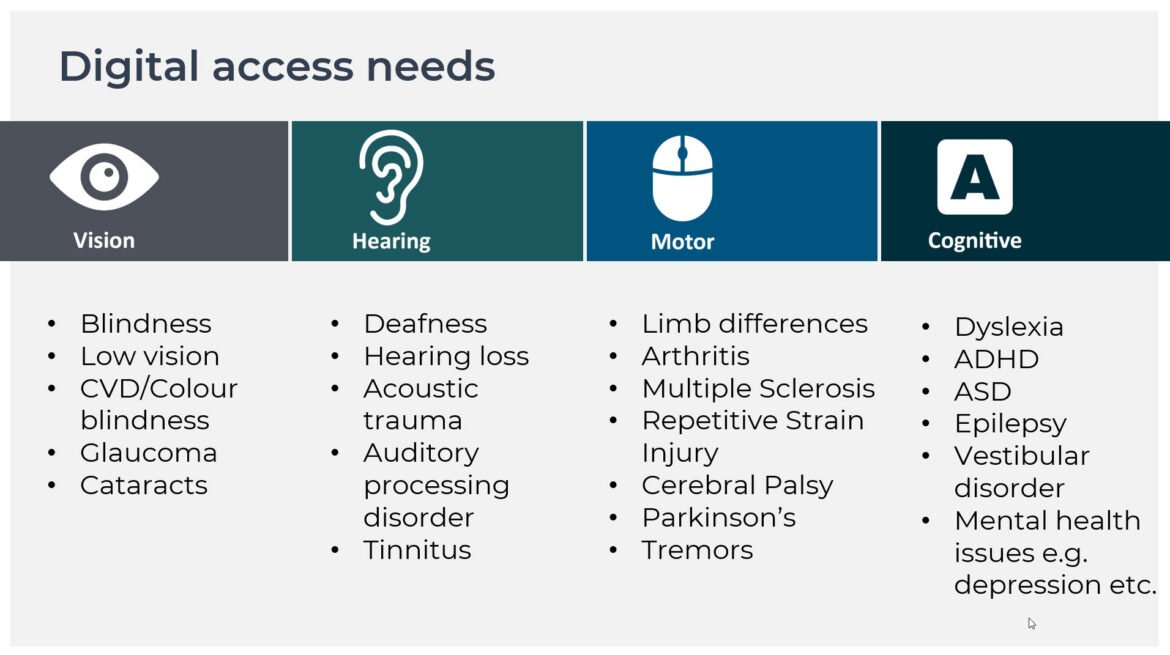
For practical actions to get started and address vision, hearing, motor and cognitive access needs, read 20 eLearning accessibility tips for more accessible learning content
For a broader explanation of how to build accessibility throughout learning design and development, explore our Accessible and inclusive eLearning – eLaHub ultimate guide
Our Designing Accessible Learning Content Programme provides a deeper practical route for practitioners and organisations that want to build the capability to apply accessibility consistently across their learning.
A measure of genuine learning excellence
For eLaHub, the introduction of this category represents much more than another award to enter. After years of advocating for accessibility to be recognised as part of excellent learning design, it provides a visible industry benchmark for what accessible and inclusive digital learning can achieve.
We will use the criteria in our own work too, as another way to challenge ourselves and the organisations we work with to consider accessibility, evidence and impact from the beginning. If the category encourages more teams to involve disabled people, test their learning properly, demonstrate its value and raise their expectations of accessible design, its influence will extend far beyond the organisations that eventually take home a trophy.
The award itself will recognise some exceptional projects. The bigger opportunity is to influence thousands of learning decisions made before those projects ever reach a judging panel.
That really is worth grinning about.
About this article
Written by: Susi Miller and the eLaHub team
Published: August 2026
Explore more with the eLaHub newsletter
For longer thought-leadership articles, in-depth practical guidance and strategic perspectives on accessible and inclusive learning, subscribe to our LinkedIn newsletter, The eLaHub Accessibility Briefing.
Each edition explores an important topic in greater depth, drawing on research, client experience and lived experience. You will find clear guidance, practical reflections and useful ideas to help you move accessibility forward across your organisation.
Subscribe to The eLaHub Accessibility Briefing [Add link]
Links and resources
- Learning Technologies Awards 2026: Excellence in Accessible and Inclusive Digital Learning criteria
- Learning Technologies Awards: 2025 winners
- Learning Technologies Conference 2026: Accessibility and Inclusive Learning session
- Learning Technologies: What it takes to win session
- Susi Miller: Announcement of the Excellence in Accessible and Inclusive Digital Learning category
- 20 eLearning accessibility tips for more accessible learning content
- Accessible and inclusive eLearning – eLaHub ultimate guide
- Designing Accessible Learning Content Programme